Saturday, December 21, 2013

Away from the Equine topics with thoughts from a Friend.


"Tolerance and apathy are the last virtues of a dying society." ~ Aristotle

Dear Friends...
My name is Deanna Johnson and I am the administrative assistant for the TheTeaParty.Net, so I watch from a distance, I listen from a distance.  But I can no longer just watch and listen, I must speak up, I must have my voice heard.

This week I had a big lesson on personal responsibility.  As an office we adopted a family in need and were able to provide them with a CHRISTmas that they wouldn't have had.  I'm almost 50 years old and when I look back at my life, "we" meaning everyone in my community and probably yours too, took care of themselves. We went to our families, our friends, charities and our churches for support.  We got second and third jobs, we didn't stand in a government line waiting with our hands out.  We lived "personal responsibility".

Thinking about this and how I am personally responsible for everything in my life led me to realize that I am part of the reason why anything that Phil Robertson said is a big deal. It shouldn't be. He is speaking his mind, his biblical beliefs and being punished for it.  What happened to freedom of speech?

I don't have the right to complain, I haven't been doing my part. After listening to the media, the politicians and the opposing sides and views, this is what I have determined. If Christians were not watered down because they do not want to offend anyone and want to remain "politically correct", then all of us would be speaking up all the time regarding our beliefs.  The "Phil Robertson incident" never would have been an issue.

God's word has never changed, we have.  We have become a society of it's okay, they can do what they want as long as it doesn't affect me.  I'm here to tell you, it does affect you, it affects all of us! I stand with those who have not been speaking, I stand with those who do not defend what is right and just, who have accepted that sin is okay because how can "I" change what someone else does?  We live in a dangerous time.  We live in a time where evil is prevailing because good men do nothing.

We are just as much to blame, if not more to blame for doing nothing. Do not allow our rights be taken away one by one.  Do not sit by silently. It is time to stand up for what it right, for what is just, it time to defeat what is wrong and what is evil.  It is time we take back our country. Let your voice be heard.  Let your voice be heard now.

Will you make your voice heard.  Take some responsibility.

Sincerely,

Deanna Johnson

Wednesday, December 18, 2013

The Economics of Equine Cooled and Frozen Semen by Paul Loomis


The Economics of Equine Cooled and Frozen Semen

Paul Loomis
Paul Loomis, Founder and CEO of Select Breeders Service, offers his insights on the cost to produce a foal from either cooled or frozen semen.

There are a number of misconceptions about frozen semen that are pervasive in the horse breeding community and one of them relates to the relative costs of frozen vs. cooled semen. We have heard horror stories of mare owners spending thousands of dollars purchasing and then trying to get mares in foal with frozen semen only to end the season with an open mare. Then there are also stories of stallion owners investing large sums of money freezing semen that is of poor quality or doesn't result in pregnancies. Many of these nightmares are the result of lack of quality control on the semen that is put on the commercial market and/or proficiency of the lab or technician that is freezing the semen. Poor quality semen, whether fresh, cooled or frozen will result in wasted money, empty mares and unhappy breeders. This article will present objective information on the true costs of using frozen semen so that stallion and mare owners can make informed decisions.
For the sake of this discussion let's assume that we are dealing with good quality frozen or cooled semen that is processed by a professional laboratory experienced in semen preservation. I will use some average figures for sperm production and estimated costs for this illustration. Obviously, if a stallion produces a larger than average number of high quality sperm per collection, then the costs will be lower because more doses of frozen semen could be produced per collection. Alternatively, higher costs would be incurred for a stallion with low sperm production or marginal semen quality.

Cooled Semen Costs to Stallion Owner

The total cost to produce a foal from either cooled or frozen semen is the sum of the costs borne by the stallion owner in supplying the semen and the mare owner in its application. The cost to the stallion owner for cooled semen will depend on how and by whom the semen collection and processing is performed. A large breeding operation with multiple stallions may find it most economical to build a collection and semen processing facility and hire trained personnel to handle stallions and collect and process semen. The semen processing laboratory will also have to be equipped with appropriate equipment and supplies. This can represent a significant upfront investment by the stallion owner and is most practical when the farm stands several stallions that are breeding numerous mares. Remember too that horses are seasonal breeders therefore the trained staff that are hired to manage the collection and processing of semen must also be employed for the 4-5 months of the year when there is no foaling or breeding going on. A stallion owner could easily spend tens of thousands of dollars to properly set up even the most basic collection and processing facility for cooled semen. The laboratory requires an incubator, phase contrast microscope, water bath, sperm counter, semen collection and processing equipment and supplies such as AV's, liners, collection bottles, microscope slides, semen extender, shipping containers, etc. and the breeding shed will need a breeding mount or phantom.
Alternatively, many stallion owners will contract with a collection facility and trailer their stallion to the facility for semen collection by appointment when a mare owner requests a shipment. In this case there is no investment in facility and equipment and the only staff required is to transport the stallion to the collection facility. In this scenario most stallion owners will pass on all of the costs associated with semen collection, processing and shipping directly to the mare owner so there is no upfront investment to recover. Shipping costs will be the same for both scenarios.

Frozen Semen Costs to Stallion Owner

For frozen semen, the costs to the stallion owner are easily calculated as the total cost for collection and processing the frozen semen, board at the freezing facility, health testing and semen storage. This is an upfront investment by the stallion owner whose costs for the frozen semen production must be recovered when the semen or breeding contracts are sold.

Mare Owner Costs

Use of a good reproductive veterinarian for mare management and insemination of either cooled or frozen semen is critical for optimum results. This is especially true for frozen semen when only a single dose of semen is available for insemination on a given heat cycle. It is equally critical with cooled semen when the quality is poor or the dose contains low numbers of motile sperm after cooling. The best results are obtained when insemination is timed to occur close to the time of ovulation and so frequent ultrasound examinations may be required. Many mare owners will send their mares into a clinic or reproductive management facility to make this easier. Round the clock, every six hour ultrasound examinations are not required if veterinarians employ modern reproductive management techniques such as ultrasound and hormonal manipulation of estrus and ovulation timing. Stallion owners can increase success rates and reduce costs by providing two doses per cycle so that mares can be managed at the home farm requiring only one veterinary examination per day just as with cooled semen. So with frozen semen, either the mare owner is spending more on veterinary care to check every six hours and wait for ovulation before inseminating a single dose or the stallion owner provides an additional dose of frozen semen per cycle and veterinary costs can be similar to cooled semen. Whether cooled or frozen semen is used the mare owner is typically responsible for shipping costs. Shipping costs for frozen semen are higher than for cooled semen but these increased costs may be offset by the fact that frozen semen can be ordered in advance and can contain multiple doses so missing a mare's ovulation due to late delivery is avoided. Multiple mares at the same location can also all receive semen in a single shipment if the veterinarian or mare owner has a storage tank into which the semen can be transferred and stored until needed.

Efficiency

A critical point when discussing the economics of cooled and frozen semen is the relative efficiency of the two technologies. For this reason it is important to consider the “cost per usable insemination dose” when comparing them. Cooled semen will live 24 to 48 hours from the time of collection and so any semen produced by the stallion that is not used for insemination within 48 hours is wasted. For many stallions, especially early and late in the season, a collection is often made for one or two mares, each receiving two doses of semen. This can lead to erratic collection schedules which may result in less than optimum semen quality. One to two billion total sperm are typically included per dose of cooled semen. Mare owners are typically charged $250 to $400 to receive a standard overnight shipment of up to two doses of cooled semen. In some breeds stallion owners will charge an additional “chute fee” or handling fee that can be significant. Over the course of a breeding season, the average stallion will be collected and ship to two mares per collection. Therefore the semen production cost per usable dose for cooled semen may be as high as $75 to $100 per dose. For popular stallions with large books of mares or stallions that produce low sperm numbers, a single dose may only be available per cycle. Weekend collections, airline or rush shipments and repeated shipments in a single cycle will add to these costs.
For frozen semen, the stallion is placed on an optimum collection schedule for efficient production of good quality semen, typically 3-4 times per week. All semen that is collected is processed into doses and stored for future use and properly stored frozen semen may remain viable indefinitely. A typical dose of frozen semen contains 800 million to one billion total sperm.
So let's examine the cost associated with breeding a book of 10 mares with frozen semen over 3 heat cycles. This illustration makes the following general assumptions with regards to sperm production and fertility for the “average” stallion:
Total sperm per collection = 8 billion (assume every other day collection schedule)
Normal sperm motility in fresh semen and good (commercially acceptable) retention of motility after freezing and thawing.
Per cycle conception rate for cooled semen = 60%
Per cycle conception rate for frozen semen = 50%
Economics blog table
Semen production cost for 36 doses of usable semen:
Average 8 doses per freeze, therefore 5 freezes required to produce 40 doses.
Average cost per freeze = $500 x 5 freezes = $2500
Board for 2.5 weeks = $400
3 clean out collections x $150 each = $450
Total Cost = $3,350
Cost per usable dose = $84
Semen production costs per heat cycle = $168
Cost for 36 doses = $3,015
Semen production costs per pregnant mare = $377
So the true comparison is the cost per usable dose ($80-$85 for frozen semen and $75 - $100 for cooled semen) times the number of doses required per pregnancy.
In our example frozen semen required an average of 4.5 doses per pregnancy using a two-dose timed insemination protocol so the total cost per pregnant mare at 50% conception rate per cycle is $377.
Because of the slightly higher assumed conception rate for cooled semen (60% per cycle) only 32 doses of cooled semen are required (4 doses per pregnancy) to achieve the same number of pregnant mares. In this case the total cost per pregnant mare would be $300 for cooled semen. However, due to the random timing of the mare's heat cycles it is likely that more than the minimum 8 collections are required to provide those 32 doses when needed for insemination adding to the overall cost per pregnant mare. As the size of the stallion's book increases the economic inefficiency of cooled semen is reduced as less semen is wasted and more doses are used per collection.
This illustration should help to dispel the myth that breeding mares with frozen semen is a far more expensive technology reserved only for elite competition stallions or stallions standing abroad and that banking frozen semen from your stallion and using it to service a book of mares is a viable alternative and/or complement to shipping cooled semen.

Thursday, August 29, 2013

Rebuilding Rider Confidence, by Mary D. Midkiff

Women & Horses, knowledge for the female equestrian; female equestrian fitness training and riding tips
Rebuilding Rider Confidence, a Personal Approach to
by Mary D. Midkiff
Part 1
An Open Discussion about Confidence Issues
Let's face it: riding horses is risky business. It takes courage, desire, coordination and balance just to mount a horse, much less direct him through his paces. It is no wonder that riders can easily lose their confidence when something goes wrong. It doesn't take much to create an environment of fear, distrust and doubt when it comes to managing a horse under saddle.
Every rider, whether novice or advanced, has experienced fear, instability, self-doubt, lack of trust and insecurity as a part of being around and/or riding horses. Everyone knows the dangerous aspects of horses due to their size, weight, natural instincts of flight or fight and self-preservation. Since we know that horses can be unpredictable, we also know that accidents can happen.
Sometimes we can go through an incident with a horse and come out better for it - more experienced and prepared for the next time. Other times, the incident may have a lasting effect and shaking our confidence and capability.
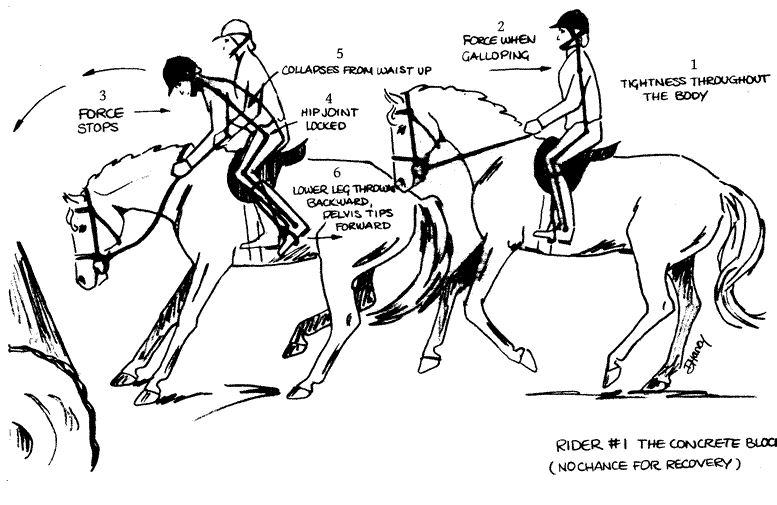
Rider #1 Drawing
Rider #1 The Concrete Block (No Chance of Recovery)
CLICK TO ENLARGE ILLUSTRATION
Lack of confidence can show up in a great many areas of our riding and our lives. Having these sensations of insecurity inside you while you are riding can limit effectiveness, cause you to think twice about riding itself, send mixed messages to your horse, and become exhausting. It can infuse your daily life with a sense of uneasiness, limiting your experiences in the riding you so love and want to pursue.
Confidence is not only tied up with the fear of getting injured. It can also be heavily involved with the need to look good and in control. We certainly don't want to fall off and get injured, but we also don't want to look bad, or embarrassed, or experience a loss of power in front of others, suggesting that we have lost control of the horse and the situation.
When an incident occurs, it is a surprise - something you have never experienced before. From then on we typically feel the fear of it (or something similar) happening again. The sense of fear when it was happening, multiplied by replaying the event in your mind, keeps you powerless and insecure. You can lose trust in yourself, your abilities and your capacity for managing a horse.
When riders comes to me with confidence issues, in any measurable amount, I make an assessment of the person and the situation. I try to find out what happened to sway their trust in themselves and their horse, and ask them if they ever truthfully felt genuinely confident on a horse to begin with.
Many times I learn that there was always an insecurity associated with riding that made it impossible to ride in a manner characterized by safety, comfort, effectiveness and balance on a horse's back.
The carefree days of children learning to ride on the farm with their grandfather's big old draft horse have become few and far between, as are the days when kids grew up jumping on the family pony bareback with a halter and rope and galloping across open fields. These youngsters learned naturally to feel free and confident even at full speed. They developed balance and coordination by just doing it.
Most children and adults today learn to ride in an urban setting in a supervised lesson program once per week on school horses. Depending on the quality of the instructors and their awareness of the needs of beginner riders, this may not be an environment that nurtures confidence in one's ability.
Many such riders start losing confidence early on when a horse or pony does not match their level of learning; the saddle does not fit their body and throws them off balance; they do not have a fitness program supporting their riding; they are taught to grip with their knees and sit in a posture that does not work; or the basic alignment of their spine and pelvis compromises their safety and puts them at risk.
The first time they feel precarious, lose their balance and are unseated or fall off can be the one time that plants a seed of fear that shakes their confidence and trust in riding. This seed will grow over time as additional incidents reinforce that lack of confidence, producing timid or fearful riders that horses detect and react to accordingly.
Shaking a deep-seated fear is not easy. The mental, emotional and physical sensations related to fear can become powerful, unconscious and involuntary in establishing a hold over us. It can gnaw at your gut so that even at the thought of getting on a horse triggers a host of negative sensations and responses.

Monday, June 17, 2013

Facts You May Not Know.....


FACTS YOU MAY NOT KNOW.....................
It takes glass one million years to decompose, which means it never wears out
and can be recycled an infinite amount of times!
Gold is the only metal that doesn't rust, even if it's buried in the ground for
thousands of years.
Your tongue is the only muscle in your body that is attached at only one end.
If you stop getting thirsty, you need to drink more water. When a human body is
dehydrated, its thirst mechanism shuts off.
Each year 2,000,000 smokers either quit smoking or die of tobacco-related
diseases.
Zero is the only number that cannot be represented by Roman numerals.
Kites were used in the American Civil War to deliver letters and newspapers.
The song, Auld Lang Syne, is sung at the stroke of midnight in almost every
English-speaking country in the world to bring in the new year.
Drinking water after eating reduces the acid in your mouth by 61 percent
Peanut oil is used for cooking in submarines because it doesn't smoke unless
it's heated above 450F
The roar that we hear when we place a seashell next to our ear is not
the ocean, but rather the sound of blood surging through the veins in the ear.
Nine out of every 10 living things live in the ocean
The banana cannot reproduce itself. It can be propagated only by the
hand of man
Airports at higher altitudes require a longer airstrip due to lower air density
The University of Alaska spans four time zones
The tooth is the only part of the human body that cannot heal itself.
In ancient Greece, tossing an apple to a girl was a traditional proposal of
marriage. Catching it meant she accepted.
Warner Communications paid $28 million for the copyright to the song Happy
Birthday.
Intelligent people have more zinc and copper in their hair.
A comet's tail always points away from the sun
The Swine Flu vaccine in 1976 caused more death and illness than the disease it
was intended to prevent
Caffeine increases the power of aspirin and other painkillers, that
is why it is found in some medicines.
The military salute is a motion that evolved from medieval times, when knights
in armor raised their visors to reveal their identity.
If you get into the bottom of a well or a tall chimney and look up, you can see
stars, even in the middle of the day.
When a person dies, hearing is the last sense to go. The first sense lost is
sight
In ancient times strangers shook hands to show that they were unarmed
Strawberries are the only fruits whose seeds grow on the outside
Avocados have the highest calories of any fruit at 167 calories per hundred
grams
The moon moves about two inches away from the Earth each year
The Earth gets 100 tons heavier every day due to falling space dust
Due to earth's gravity it is impossible for mountains to be higher than 15,000
meters
Mickey Mouse is known as "Topolino" in Italy
Soldiers do not march in step when going across bridges because they could set
up a vibration which could be sufficient to knock the bridge down
Everything weighs one percent less at the equator
For every extra kilogram carried on a space flight, 530 kg of excess fuel are
needed at lift-off
The letter J does not appear anywhere on the periodic table of the elements

Brain Horsemanship

This is an excellant article by a lovely woman, Felicia Britt, a mother, wife, lover of God's creatures, and a really good trainer of horses!!!


UNDERSTANDING BEGINS ON THE GROUND


I is for INTEREST..... Foals are so curious. They come to you readily and investigate everything. Unfortunately, often by the time she is a yearling, she has been convinced that halters mean work, work means circles, circles mean boredom, so she dislikes halters. Or, more accurately, people with halters. Her curiosity has been squelched and her interest diluted to a passing glance. Whether a weanling colt and a horse you've had for years, maintaining her interest is where every teachable moment resides. When I start a horse, I want to expose her to everything I can think of INCLUDING the kitchen sink! Think of her mind as one of those tiny rubber bands you put in a mane. You want to stretch her tolerance, little by little, until her brain is so flexible it like a hundred foot long bungie cord! As I describe some suggestions keep in mind that the benefits are two fold. We are not only using a variety situations to pique interest, but at the same time introducing some serious desensitizing exercises for a much braver horse later. If done correctly, your horse will look forward to your time together with anticipation and wonder. Your training sessions can't always be fun and games, but they can certainly begin and end with them!
Start by placing an object in an arena or pasture. I like to hang something on the fence where I usually work. Start with just one item, then before long you will have a half dozen. Lead your horse to that area and go through your normal routine, completely ignoring the object. Observing him closely will tell you the proper distance to stay away from the item, to keep anxiety to a minimum. Your ultimate goal here is to teach him self-control. His instincts tell him to run, but your body language tells him it is okay. It is critical that you appear completely unaffected by the object. He is going to scrutinize your tone of voice, posture and expression for even the slightest indication that it is time to RUN. If he is anxious and you stop your routine and pet him, you are rewarding his fear, as well as confirming it. If the object is more distracting than interesting, move farther away, but continue your routine. When everything else stays the same, especially you, he begins to go through his mental list and ask himself questions. Your self-control teaches him self-control. Your calm demeanor conveys to him that the object is a non-issue. Stopping and staring at it simply doesn't work for me. I think he just wonders WHEN it is going to eat us both.
For horses that are more sensitive to change, I usually do not do this next step until she has experienced several different objects hanging on the fence during multiple sessions. By then, she is really beginning to wonder about all those 'things' hanging around. Then, at the end of a lesson, I lead her over to the object, let her touch it with her nose once, then lead her away. Often, you will hear a big sigh...question answered. And boy! Did you get a lot of respect from her as you displayed so much courage in the midst of such danger. (A scary stuffed teddy bear sitting on top of the fence post). When you begin to add various objects to this game, it becomes some major league desensitizing. But, the great part is the day she walks into the arena LOOKING for objects to investigate. I love to witness this transition and delight in ignoring the elephant in the room until she is dying to go exploring. At this point, I begin to say the word “touch”, just before her nose makes contact with the object. Remember to walk away immediately after a single touch. Before long, you are actually SENDING her to touch things. This 'touch' cue transfers beautifully to the trail. Whenever one of my trainees sees something 'spooky', whether we are leading or riding, I give her some slack and say 'touch'...then, fear becomes curiosity because she knows the game is not scary, so this must not be either.
There is a beautiful, black mare I have in training named Love. She came to me as a 6 year old retired show horse who had never been ridden out of the show ring. Whether a youngster or a finished show horse, I always put my first 30 rides on one in the woods. I feel nothing solidifies the trust bond better, than a horse in unfamiliar surroundings having to fully rely on her handler. I feel that exploring the forest instills, or in this case, rekindles a horse's curiosity and sparks her courage.This mare had never been on a trail in her life and was simply afraid of everything....including butterflies and grasshoppers!


As time passed, Love progressed nicely and fell completely in love with the 'touch' game. She would come into the arena(which she formerly hated)like a bull looking for a target. She was so fun to watch as she grew braver and braver. In the woods, she had to 'touch' everything. It would take us an hour to go 200 yards, but I let her. In my mind, she was erasing years of stress...it was all about the process. I knew the product would come.
The best day of all was when Love's owner, MJ, and I went for a trail ride on an adjacent cattle ranch. MJ was on her mare and entered the pasture gate a few yards in front of me. I had instructed her on the intricacies of the 'touch' technique and she was confident and determined to impress. Love immediately became curious about the brown blobs that littered the ground. As I observed from behind, MJ dutifully approached each one and said 'touch' and moved on. After about the twentieth pile, I thought I was going to fall off my horse laughing as I wondered if she would 'touch' all 12,572 cow pies. She didn't, but my ribs were sore for a week!
Since every unfamiliar scenario cannot possibly be reproduced, the goal is to give your horse the tools to deal with situations as they arise. He will learn self control and so must you. If you are anxious and tense, expecting a train wreck...you usually get one. A calm demeanor shows you have taken on a confident leadership role. If your horse has passed this stage of his training, it is still critically important that your time with him stay interesting. Resist the temptation of allowing his conditioning to become mindless lungeing and trail rides becoming dull and unchallenging.
As we have discussed, skills are taught layer upon layer. Decide what you are going to work on that day and what new elements you are going to introduce. I like to follow the same pattern most of the time. 1) Warm Up His Brain(review) 2)Warm Up His Body(conditioning) 3)Today's Lesson(new element) 4)Build Confidence(review) 5) Relax(cool down & flex) This pattern works for me with horses at all levels of training. Even if your horse is under saddle, begin on the ground. Go through everything your horse has learned recently. Mix it up. Do several skills in a row, increasing the difficultly and speed as his brain comes alive. I like to do what I call circuit training. Just like in the gym, varying the skills, conditions more than just muscle...the brain has to concentrate to keep up. For example: I lead the horse at walk, stop, back 4 steps, stop, wait, pivot 90 degrees, back 4, trot off, stop, wait....stand...pivot 180 degrees, switch sides and repeat entire circuit, leading from the right side of the horse. Then, send the horse out on the circle, walk relaxed , pick up trot, trot 2 circles, walk 2 circles, stop. Pivot 180 degrees on circle and repeat. Then trot on off side to obstacle course set up in the yard and practice trail elements. Trot back to arena and go through entire 'set' again. This time adding a canter, or side pass, or pivot on the forehand. Reverse & repeat on the other side. Whatever your horse has learned, include it in the circuit. Then, if your under saddle, mount up, and do the entire circuit again. Be clear with your communication, keeping your posture, voice and expression balanced. Begin to minimize your cues, while picking up tempo. In my experience, it is great way to keep him interested and really using his mind. Make it hard, purposefully. HAVE FUN!


Obviously, this is one of my favorite areas of training. It is challenging for the horse and handler, both physically and mentally. Best of all, the workout you develop for him is limited only to your imagination and to be sure, the rewards are great. He will begin to look at your time together with interest and wonder. It is a place where he doesn't just yield to your authority, but CHOOSES to be in your company. That is the heart of a horse....his will.
Every moment you spend with your horse, you are training him. Make the most of it. Believe in yourself, so he will too. Control the territory, so he will follow. Communicate clearly, so he will understand. Kindle his interest, so he will let you in......and....finally...

Next Time      N – NEVER NEGOTIATE

What is the Difference between Eagala and Epona Therapies?

The was the question asked recently  to which this answer followed.

 
What is the difference between Eagala and Epona Therapy applications with regards to horses? Is one better than the other and why?
 
Hi Keith - Good question. I have been in this field since 1998 and met Eagala co-founder, Greg Kersten, before Eagala formed in July 1999. Kersten now has OK Corral Series and speaks more of an Equine Assisted Philosophy for EAP. I have attended a variety of trainings (you can see them on my profile), including Eagala and Kohanov's EponaQuest.
Eagala is a solution focused team approach similar to a ropes course, only the 'ropes' (the horses)have an opinion. The EponaQuest approach has interactive round pen work and can be more shamanic in approach to emotional fitness. Both have different tools for this work, and I have used both depending on the goal with the client.
You can read here about certifications (which needs to be updated with some additions to the field): http://equineassistedassets.com/faqs-certifications-in-the-equine-assisted-field/
and here about the history of the approaches and organizations:
http://equineassistedassets.com/history-of-ea-orgs/

Depending on the population you are working with, different approaches are good to have in your tool kit. I helped to form the Equine Assisted Education Association (E3A) http://www.e3assoc.org (to hear an interview on the method http://e3assoc.net )which trains and prepares a team of people to facilitate in a coaching model where both members of the team are dually trained in horse knowledge and facilitation practice. I think all of the models have merit. You might really like Chris Irwin's EAPD training, too.

I like the team approach because having eyes on the clients AND horses can be challenging. I also like the profound connection that can occur in the EponaQuest (largely based on Barbara Rector's AIA model http://www.adventuresinawareness.net/ and modified by Kohanov's own experiences. If you are working with wounded warriors, having some PATH training is also helpful in having knowledge of how to best facilitate physical disabilities. It is a great field, and who you are serving can help determine what tools you may want to have. I will be happy to answer any questions you may have.
By Pam Salem

Saturday, June 15, 2013

Land Grab stemming from Obama Presidential Memorandum!


 A massive land grab is underway in Missouri and Arkansas. NGO’s (Non-Governmental Organizations) are lining up other states to be included in the Department of Interior’s “National Blueway System” designation. The Blueways System stems from Obama’s “America’s Great Outdoors” Presidential Memorandum, under which Secretary of Interior Salazar issued Secretarial Order #3321. (scroll down)
The first Blueway designation occurred in May 2012, across the States of Vermont, New Hampshire, Massachusetts and Connecticut. That watershed encompasses 7.2 million acres. The “White River National Blueway” is 17.8 million acres, and includes 60 counties across Missouri and Arkansas. Not one elected official from these 60 counties knew a thing about the designation, or the plans put forward by the “nominating committee”.
Private property rights advocates knew nothing about the plan either, and when they’d found out about it, the designation had already been assigned. The “stakeholders”, NONE of whom represent or are actually private land holders in the area, have put together a significant list of “Strategic Objectives” to control the use of land within the 21,000 square mile area.
In the Memorandum of Understanding including the triumvirate of Federal Agencies designating and collaborating on the “National Blueway System” it states:
“Nothing in this MOU is intended to authorize or affect the use of private property or is
intended to be the basis for the exercise of any new regulatory authority.”
Yet when you examine the Nomination pdf that the “stakeholders” put forth to acquire the designation, there is no way the objectives can be met without regulation.
First, let’s have a look just who the non-governmental stakeholders are and then what they propose to accomplish with this Blueway.
We have only two entities involved from Missouri. The Missouri Audubon Society and the Missouri Nature Conservancy along with their sister groups in Arkansas. Then we have some National level groups, being Ducks Unlimited, The National Wildlife Refuge Association, The Conservation Fund, The Arkansas Canoe Club, The Arkansas Association of Conservation Districts and two local businesses. No property rights advocates, no land-owner groups, or farm groups and, importantly, no notification duly elected officials in Missouri at all, and only a few cities in 1/3 of the State of Arkansas even heard about this Blueway designation.
Now let’s get to the on the ground effects of the White River Blueway.
The nominating committee, consisting of the groups above and one State agency from Missouri and several from Arkansas, spelled out just what their plans are for the 17.8 million acres in the watershed in the Nominating pdf. Here are a few highlights from that plan, which you can find copied from the document at prcnews.org.
• Acquiring at total of 548,500 acres throughout the watershed
• Placing 10% of farms into conservation programs and develop Conservation Programs for 75% of farms
• Reducing on farm water consumption by 20%
• Increase flooding of agricultural land for wildlife habitat by 10% in the first three years and then an additional 20% in 3-7 years
• Set back levees to restore historic floodplain habitat
• Control encroachment on existing floodplain
• Establish a minimum 180 foot wide vegetative buffer zone along all surface water
There is no way this can be achieved without regulations being promulgated to enact it. A 180 foot buffer around all surface water means all streams, seeps, marshes, rivers, ponds and lakes. Thankfully, unless the definition gets changed, this buffer zone doesn’t include wet weather creeks.
The on the ground effects of this plan would absolutely annihilate agriculture within the 60 county area. And agricultural is by far the biggest economic engine within the region. Tourism is far, far behind. And with such a great economy, the idea that tourism is suddenly going to explode as an economic engine is beyond ridiculous. Nonetheless, that is the apparent economic benefit we are all supposed to gain from this designation.
The implementation method of this designation and the “integrated land and water management” that are to be achieved through this designation are far reaching and far from friendly to those who live and work on the land within this watershed. According to a statement from the Secretary of the Interior, the plans are to establish 5 National Blueways per year for the next five years ultimately achieving 25 National Blueways throughout the nation. The very people affected have been completely cut out of the process and left out of the loop on this issue. No public meetings, elected official notification, or Federal Register comments on the viability of a Blueway designation have been offered. Nor are they required. As of January 9th, 60 counties in two States have been enrolled in an internationally driven “conservation estate”.
So if you don’t live within the designated area of the White River National Blueway, don’t worry, it will be coming to your area soon. Minnesota and Indiana have National Blueway nominations under way, and they are not far from being completed. Alabama is taking a novel approach in stringing together a myriad of Blueways and apparently waiting until that is achieved to bring in the final national designation.
The citizens within the White River Blueway designation are mounting a truly grass roots effort to overturn the designation and rescind the specific Memorandum of Understanding that will be used to place the Audubon Society and Nature Conservancy in the position of deciding what, if anything, happens on their land.
The method of implementation and the management processes are so opaque that when a gentleman, striving to get specific information on the White River Blueway, spoke with a representative from the Department of Interior he was told, “We don’t know what’s going on ourselves.” After a day of phone calls where no one could even figure out who might be in charge of anything associated with this Blueway designation, he had to give up with a nebulous hope of his question possibly being answered…..eventually.
We need all boots on the ground to beat this one. If we are successful in turning over this designation, it will be because extraordinary effort was made by a great number of people. To find out how you can help, please go to SecureArkansas.com, PrcNews.org for more information and also contact all the members of the House Natural Resources Committee and ask them to overturn this designation and require the Department of Interior to hold public meetings and notify elected officials about any potential Blueway designation.
Without our knowledge, without our consent, and without representation in the process, the Blueway designation is unlawful and patently un-Constitutional.

Wednesday, June 12, 2013

Urban Agriculture


Burpee CEO Reblooms Urban Agriculture
At the keynote speech of the Urban Agriculture Conference in New York City, organized by The Horticultural Society of New York, George Ball, Burpee Chairman and CEO told leading-edge urban gardeners and rooftop farmers to “stop and smell the cut flowers”.
Most urban agriculture projects consist mainly of vegetables and herbs with occasionally a few flowers on the side. Ball, a 35 year veteran of both the cut flower as well as the vegetable business, urged the participants at the May 16th conference held at the Kimmel Center of New York University, to meet the great potential, as well as pent-up demand, of fresh cut flowers that have almost vanished from urban homes, parties and other public and private events.
“Think of cut flowers as an endangered species” quipped Ball. “If you grow flowers in a 1-2 acre farm or garden, you not only serve customers who have not been pleased for over 30 years, but also you avoid regional competitors and government regulators in the fresh vegetable business.”
Ball went on to discuss the attractiveness of a cut flower urban farm to employees as well as customers. “You will have volunteers line up early every morning to work on a seasonal, outdoor cut-flower farm—vegetables don’t have that kind of deep and universal attractiveness.”
Ball added that the contemporary flower industry is dominated by huge exporters from countries 4,000-6,000 miles away, whose flowers are picked “green” when the buds are not fully pigmented (much as a tomato is picked green) and shipped by air-polluting jumbo-jets to wholesalers who keep them up to a week in storage. Finally, they are distributed to an ever-decreasing number of retail florists. “Today most florists are gift shops with a small cooler in the back filled with pale-colored flowers from Asia, South America or the Middle East” Ball said. “The consumers have fewer choices in flowers than they have in vegetables in a supermarket.”
Ball also pointed out the latest research at Rutgers University by Jeannette Haviland-Jones that proves that fresh flowers in the home elevates mild depression or other mood disorders. “So long as the flowers are proportionate to the room—not too many, not too few—they transform the space into a place of happiness”, added Ball.
“Vegetables are fuel for our body, but flowers connect with the deepest parts of our spirit.”
The Urban Agriculture Conference at the Kimmel Center was attended by over 300 urban gardeners and city farmers from across the nation.

The above is a copy of a press release that went out last week. Your comments are welcome! And please pass along to other bloggers if you have a chance. Thank you.

Saturday, June 08, 2013

Ten Golden Rules of Horsemanship


Ten Golden Rules of Horsemanship by Dr. Bruce Nock
1.  Aids and cues are signals for change.  A cue is a sign designed to elicit a particular response.  An aid, similar to a cue, is used to modify the movement or balance of a horse under saddle.  Often the two words are used interchangeably.  They are both directives that tell a horse to change something that he is doing.
 
2.  Signals should stop as soon as the horse begins to make an acceptable response.  The cues and aids should remain silent until the next request as long as the horse is staying responsive to what was asked.  If cues and aids are ongoing, horses become desensitized to them and eventually stop responding.
 
3.  Signals should never be ignored.  Don't take no for an answer unless, for some reason, the horse is unable to respond.  Primary signals can be supported by secondary signals (whoa followed by passive resistance with the reins, for instance).  Pressure with the signal is increased gradually until the desired reponse is obtained.
 
4.  Signals should be distinct.  If the horse is unlikely to respond satisfactorily, don't signal.  It is much better to focus on improving a horse's mental state when he is frightened or excited than to give him commands that might only exacerbate the situation by escalating his emotional state even further.  Don't give conflicting signals.  Don't give double signals if they can be avoided (stop while I am driving you forward into the bit).
 
5.  A response should be easy for the horse to make.  Unless you are conditioning a horse for higher performance, if you ask a horse to do something that is difficult for him to do, you will have to be forceful to get him to do it.  Break training down into small steps and work through them one at a time and the difficulty will be overcome in time.
 
6.  Rewards enhance sensitivity to signals only when they immediately follow an acceptable response.  A reward should always be a consequence of the rider's initiative rather than that of the horse.  Always rewarding a horse is counter-productive because we know they learn to expect it.  Reward more in the beginning of a training session to encourage the desireable behavior and then less and less as the horse "gets it."
 
7.  Undesirable behavior worsens only if it is rewarded.  An undesirable behavior must be corrected every single time that it occurs, with absolutely no exceptions for optimal effectiveness.  The hardest behaviors to extinguish are those that have been rewarded intermittently.
 
8.  Undesirable behavior extinguishes if it is not rewarded.  A correction discourages undesirable behavior because it prevents the horse from attaining the reward, not because it punishes the horse.  Corrections supress undesirable behavior permanently.  Punishment does not.  Punishment often has severe negative side effects.  Corrections do not.  Corrections encourage proper behavior while punishment does not, and punishment usually begins where human knowledge ends.
 
9.  The reaction to a stimulus will dwindle if the stimulus continues while the reaction occurs.  Here we are not talking about "flooding" or "sacking out," methods still used to desensitize horses through force, creating horses that lack affect and perform in a mechanical sort of way without enthusiasm.  Burying horses in grain or sand up to their neck is one method of "flooding."  For a claustrophobic animal, being buried alive is like that room in the novel 1984 where you are imprisoned with your greatest fear.  The trick is to implement the next golden rule, no. 10, without the fearful reaction occurring.  (ESCT, for instance, works exceptionally well in doing this).  There is a point in ESCT when maintaining the stimulus while the horse is being pulsed with the ESCT pulser can produce quick and effective results.  This technique is introduced only after a series of short approaches and retreats while using the pulser and after the horses initial reactivity has dropped.  The pulsing interrupts the fear cycle and allows the horse to accept the stressor while it is in place.
 
10.  The reaction to a stimulus will dwindle if the stimulus terminates with the reaction occurring.  Just as a release of an aid is rewarding when riding, so is the withdrawal of a stimulus that arouses even slight apprehension.  Generally, the smaller the size, the less the sound, the less the movement and the less the structural complexity of the stimulus, the less the reaction to it.  Desensitization is a process that goes more quickly when you proceed slowly.  The approach and retreat method of introduction and removal of the stressor is one of the hallmarks of good training and part of the ESCT process.  Respecting the horses fear and working with it instead of against it moves desensitization along much more quickly.  Working with a flag, for instance, starts by introducing the flag low and folded and out of the horse's personal space, then gradually coming closer, unfolding it, touching him, raising it next to him, raising it over his head, etc.  It is a process.

Wednesday, May 01, 2013

SO..You are Thinking About Selling A Horse by Bridget Brandon

So You Are Thinking About Selling A Horse
Bridget & home bred~Journey   
         Equi-Partner~Bridget Brandon
ASEA Certified Senior Equine Appraiser and Expert Witness 
Tel. (
817) 454-4537  Texas, USA  
ValueMyHorse.com
 

 Bridget offers some insight on the process of preparing your horse for sale.There is much involved in selling a horse and of course you want to get top dollar. Selling a horse can also be hard work and stressful if you are not properly prepared. Here are a few tips that will hopefully make the process a positive experience for everyone.   
Preparing Your Horse For the Sale:
  • Current on shots and coggins
  • Registration papers are in order and you have proof there of
  • Show records are updated and in order
  • Trimmed feet or shod
  • Bathed, clipped and cleaned
  • Well fed and fit
  • Prepared Bill of Sale
 The Sales Setting:
  • The buyer should try the horse at a facility where the horse can perform for the purpose it is being purchased
  • Setting should be well lit
  • Clean setting
  • Easy to get to
  • Be on time and prepared
  • Buyer should see the horse tacked up and un-tacked
  • Always ride your horse for the buyer first
  • Present a "copy" of the shot record, coggins, show record and registration papers
 Other Things to Keep in Mind:
  • Point out any soundness, vices or health issues in advance
  • Be able to explain accurately temperament and ability
  • A horse selling out of a sales or trainer's barn typically will bring more money. If using an agent, be sure to agree on a commission and fees up front.
  • If trying a horse at a show, allow the horse to finish competing in its classes before trying it.
  • It is standard for the buyer to try the horse at least twice.
  • Always Execute a Bill Of Sale.
  • A buyer has a right to a pre-purchase exam.
One last word of advice, be realistic about your horse's ability and pricing.
An example of a well prepped horse for sale 


We can all be guilty of wearing "rose colored glasses" when we are emotionally involved in our horses.

So seek advice from a friend who is an experienced horsemen or a professional prior to placing your horse for sale.

Please contact me if you have any questions on the sale process!

Wednesday, March 27, 2013

Great time coming up for New Yorkers in Balston Spa.....

http://www.cceequine.org/saratoga_horse_symposium.html

Classical Training VS Modern Riding

Having just finished an important book regarding the misuse of modern training method called Rollkur, I thought it important enough to pass along info as I become aware of.

Tug of War:Classical Versus "Modern"Dressage, Why Classical Training Works and How Incorrect "Modern" Riding Negatively Affects Horses 'Health by Dr. Gerd Heuschmann


rollkur/http://midwestnha.wordpress.com/

Good blog regarding the use of extreme training called rollkur......

Chocolate Horse Farm Gypsy Vanner Horses: Fear of Riding? From Horse&Rider | Equisearch

Chocolate Horse Farm Gypsy Vanner Horses: Fear of Riding? From Horse&Rider | Equisearch: Fear of Riding? From Horse&Rider | Equisearch

Chocolate Horse Farm Gypsy Vanner Horses: Top Five Horse Buying Mistakes (By Iian)

Chocolate Horse Farm Gypsy Vanner Horses: Top Five Horse Buying Mistakes (By Iian): Top Five Horse Buying Mistakes Published January 2, 2013 | By Iain Top Five Horse Buying Mistakes Equine Purchasing , www.USAHor...

Chocolate Horse Farm Gypsy Vanner Horses: New Arrival

Chocolate Horse Farm Gypsy Vanner Horses: New Arrival: Just a quick note to announce the birth of a Sparky and Lora foal......and it is a boy!  Enjoy the Roxie Show! http://www.photoshow.com/wa...
This colt has been named CHF Otis after a lovely old gent who taught me to drive the tractor.  Some name their Gypsy Vanners lovely Celtic names that need a little help in pronouncement, and we have some with versions of the Celtic, but most are named with regard, for people we have walked with a while enjoying the journey .  Lora is so named for Laura Talbot, one of the twin daughters of Julian and Helena Talbot.  We also have Lucy, so named for her twin.  Producer's Heiress is one of the exceptions, and yet, Heiress refers to a daughter's love of horses and is hers should we not be able to care for her one day.  I keep a notebook of names and their significance for each new arrival's benefit.

Otis was born March 18th on a cold and very wet day.  He was up with a little help in order to get Mom and Babe inside where the straw was dry and the wind at the door.  He is now three months old and quite the young man....very friendly and incredibly curious....all normal for us.  He will wear a halter but sometimes it just to play with, loves scratches, is fairly relaxed picking up his feet unless he is in full play mode.  Felecia taught us to play horsey style with the foals and it is fun if exhausting.  So obviously they think every time you show up it is play time.  However, he know understands there are quiet times with the humans too.  i.e. scratching.......


Otis is for sale at weaning and will be sold as a gelding.  Though he is a lovely proper colt, there are an abundance of exceptional stallions among the Gypsy Vanner, Cob, Horse ( what ever your preferance) world here in the states.  We do not breed every one of our mares every year, shocking to some, but given the market and the reality of too many horses being uncared for, it only makes sense to be selective.  Otis is the only foal on the farm this year, as has been the case for the past several years.  The previous foals are in great homes and doing well.....we like to keep track and find friendship an element of the sale that is special to say the least.  We hope someone will find Otis as engaging as we do and give him a good home, treating him with kindness for all of his days. AND lots of scratches!!!!

Chocolate Horse Farm Gypsy Vanner Horses: SO! You want to buy a horse!

Chocolate Horse Farm Gypsy Vanner Horses: SO! You want to buy a horse!: Ides of March.....hearing the reference reminds me of the saying...March, in like a lamb...out like a lion and visa versa.  Well, that is wh...

Friday, March 15, 2013


Hello TA Sunshine!


Enjoy our short presentation of TA Sunshine, Chocolate Horse Farm's, Arabian gelding!  Excellent trail horse, typical busy personality...can open most anything he sets his mind to.  Enjoy!

Saturday, February 16, 2013

BBC Romany Gypsies

LIFE ON THE ROAD AGAIN

George Harber and Frank Ball
ROMANY RAMBLES | George and Frank are proud Romany Gypsies
There is a group of people living in the south east who have a unique history. Unfortunately this also includes discrimination and persecution. Inside Out's Paul Ross joins a modern-day Romany Gypsy family as they go on the road.
Frank and Prissy Ball are Romany Gypsies.
They have lived on and off the roads most of their lives, ending up in a chalet on a Gypsy site in Gravesend.
When their home burned down, they reluctantly moved into a council house eight years ago, even though they aren't very happy here.
Gypsy wagon  - vardo
Despite having settled in a house, the Gypsy way of life beckons
Frank says "It's got comforts but I'd rather be back to my old life. It seems strange to say it but, sometimes it feels like a prison."
Simon Evans is a Gypsy historian. He says that nowadays the majority of Gypsies are settled, living in houses rather than caravans.
"People who have been sheltered by brick and mortar find it hard to understand how travellers growing up in a small caravan would feel claustrophobic in a bigger house."

Gypsies and travellers

There is an important distinction between travellers and Gypsies.
There are the Romany travellers, the Gypsies, and then there are the Travellers, who are either traditional or new. The New Travellers are those who chose the nomadic lifestyle.
Goat on a truck
Taking to road means taking everything - even the goat!
Romany travellers come with a rich cultural heritage, and with a language of their own, the Romas are an acknowledged ethnic minority.
The traveller identity centres on the nomadic lifestyle, living on traveller sites around the country.
Traditionally, Gypsies worked at seasonal farm work, picking fruit, flowers or hops. They also worked as knife-sharpeners, pot-menders and basket-makers.
They followed a well-established route, returning at regular intervals depending on the kind of service they provided. A peg-maker might return sooner than a knife-sharpener as the knives outlived the pegs.
Frank's cousin George Harber lives with his family in West Kingsdown in East Kent.

Romany heritage

Like Frank, the Harber family are now settled and live in a house, but the Romany heritage is important to George.
"My parents were brought up in a caravan, or wagon, called vardos in Romany."
Frank owns two vardos and has been working on restoring them for the last year or so. It's been hard work.
Horse and Frank Ball
Horse trading is a traditional Gypsy occupation
Like every summer, Frank and George are taking their families, wagons and horses and going on the road.
This time they are all heading for the village of Shipbourne, just north of Tonbridge in Kent. Here they set camp on a large common, perfect for Frank and George's purposes.
Problem is though that the common, although called so, is privately owned, so they are in fact trespassing.
Frank and George are used to getting visits from the police wherever they go.
"It don't normally take long until the police turn up and say you're not welcome. We tend to beg for an extra day or two and then we move somewhere else."

Part of the Kentish heritage

Discrimination and persecution has followed Gypsies since time began. The first written record of Gypsies in this country was in 1505.
Their exotic appearance - with dark skin and colourful clothes - it was believed they came from Egypt.
Is it thought that's where the name Gypsies come from, Egyptians was shortened to 'gyptians which eventually became Gypsies.
Evidence show that Gypsies probably came to the British Isles from Asia and the Middle East via Europe.
Frank Ball in his vardo
Frank has restored this 107-year-old vardo
The Romany language stems from Sanskrit, an Indian language spoken on the Indian subcontinent in the ninth century.
Anglo-Roma Gypsies are now recognised as an ethnic minority under the Race Relation Act.
Simon Evans tells us about the history of the Gypsies in the area.
"The Romany Gypsies represent the largest ethnic minority in Kent and the South East counties.
"The Romany culture is intrinsically part of the Kentish culture, it's one of the things that define the place."

Centuries in the area - still not part of society

Despite being a great asset to the region, travellers and Gypsies are still persecuted and the camp set up on the common in Shipbourne is soon visited by the local police again.
"They come to send us a message that they are watching us."
Travellers have always been on the fringes of society.
Most villagers in Shipbrough aren't that bothered with the travellers' visit to the common, although some tell us privately that they've always hated the Gypsies.
"Do you understand why people object to you", Paul asks.
"The best thing about this life is, you wake up in the morning and you feel free - you've only got one door and you've only got one way to walk and that's outside."
Frank Ball
George can't understand it.
"Thing is, we've been doing this all our lives, and if people aren't used to us now, that's their hardship."
For Frank and George and their families this is more than just a way of life, this is their heritage.
http://www.bbc.co.uk/insideout/southeast/series6/gypsy_travels.shtml

Wednesday, February 13, 2013

Gypsy Lore

A friend sent this and I thought some of you might find it interesting!  If you know the secrets, I hope you share. 
 
There is a secret method by which certain persons are supposed to be able to acquire power over hard-to-manage horses.  As is well known to students of Gypsy lore, Gypsies are reputed to be in possession of some secret by which they can render vicious horses entirely tame.
Opinions are divided as to whether this secret consists of the application of a certain scent or balm to the horse's muzzle, or whispering into its ear a spell or incantation.  It has been claimed that the Gypsy horse charmer applies anise seed to the nose of the animal.
Horse whispering has also been popular among many other peoples. The antiquary William Camden, in his recital of Irish superstitions, states, "It is by no means allowable to praise a horse or any other animal unless you say 'God save him.'  If any mischance befalls a horse in three days after, they find out the person who commended him, that he may whisper the Lord's Prayer in his right ear."
It was said by Con Sullivan, a famous Irish horse-whisperer of the eighteenth century, that practitioners of the art could not explain their power.  This was affirmed by those who practiced it in South America, where a couple of men could tame half a dozen wild horses in three days.  The same art was widely practiced in Hungary and Bohemia, and it was from a Bohemian Gypsy that a family in the county of Cork claimed to hold a secret by which the wildest or most vicious horse could be tamed.  For generations this secret was regularly transmitted as a parting legacy at the time of death from the father to the eldest son.
Throughout the north of Scotland there are members of a secret society for breaking in difficult horses, which is believed to be called the Horseman's Society and which purports to trace its origin to the Dark Ages.  Only those who gain their livelihood by the care and management of horses are admitted, and the more affluent and better educated are jealously excluded.  Many farmers entertain a prejudice against the members of the society, but they are forced to admit that they are always very capable in managing their teams and can perform services that would otherwise require calling in a veterinary surgeon.  They are usually skilled in the knowledge of herbs and medicinal plants, and a great deal of folklore surrounds them.  It is stated that they hold their meetings at night in the clear moonlight, going through various equestrian performances with horses borrowed for the occasion from their masters' stables.
There is also said to be an inner circle in the society in which the black art and all the spells and charms of witchcraft are studied.  Members of the inner circle are said to be able to smite horses and cattle with mysterious sickness, and even cast spells over human beings. One local writer stated that the inner circle of the horsemen employ hypnotic influence both on men and animals, as it is said certain North American Indians and some of the jungle tribes of Hindustan do.
On one occasion the services of the famous Con Sullivan were requisitioned by Colonel Westenra (afterward earl of Rosmore), who possessed a racehorse called Rainbow.  The horse was savage and would attack any jockey courageous enough to mount him by seizing him by the leg with his teeth and dragging him from the saddle.  A friend of the colonel's told him that he knew a person who could cure Rainbow, and a wager of £1,000 was laid on the matter.  Sullivan, who was known throughout the countryside as "the Whisperer", was sent for.  After being shut up alone with the animal for a quarter of an hour, he gave the signal to admit those who had been waiting on the result.  When they entered, they found the horse extended on his back, playing like a kitten with Sullivan, who was quietly sitting by him, but both horse and operator appeared exhausted, and the latter had to be revived with brandy. The horse was perfectly tame and gentle from that day on.
Another savage horse, named King Pippin, took an entire night to cure, but in the morning he was seen following Sullivan like a dog, lying down at the word of command, and permitting any person to put his hand into his mouth.  Shortly afterward he won a race at the Curragh.
Sullivan's statement that the successful whisperer is not acquainted with the secret of his own power may well be true.  As Elihu Rich (in E. Smedley's The Occult Sciences, 1855) states, "The reason is obvious.  A force proceeding immediately from the will or the instinctive life would be impaired by reflection in the understanding and broken up or at least diminished by one half.  The violent trembling of the animal under this operation is like the creaking and shivering of the tables before they begin to 'tip', and indicates a moral or nervous force acting physically, by projection perhaps from the spirit of the operator.  None of these cases are, after all, more wonderful than the movement of our own limbs and bodies by mental force, for how does it move them with such ease?  And may not the same power that places its strong but invisible little fingers on every point of our muscular frames, stretch its myriad arms a little further into the sphere around us, and operate by the same laws, and with as much ease, on the stalwartt frame of a horse?"